


















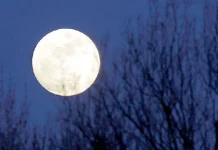







The full moon is a very suggestive natural phenomenon that has always inspired popular culture but also artists and philosophers, and in more modern times, novelists and filmmakers.
Folklore has taken possession of the suggestive light emanating from the full moon that illuminates the darkness to day, giving way to legends that have been handed down into the modern era. With the arrival of electricity and the night lighting these legends have diminished a bit, remaining in the plot of series B films and horror movies.
In the medical field, since ancient times, the moon has been attributed to influence various ailments such as mental illness, epilepsy, night blindness and other diseases.
It was once thought that sleeping in the moonlight could cause nocthalopia, a visual defect characterized by difficulty in adapting to the dark, which can go as far as night blindness. It is an acquired or genetic disease, including a form of hypovitaminosis A (Vitamin A deficiency), known since ancient times because it was widespread in childhood (see Wikipedia entry: nictalopia). Epilepsy
toohas always aroused a mixture of interest and fear. In ancient times it was thought that it was triggered by full moon nights. In modern times, however, targeted research has given conflicting results that refer not to a direct effect of the moon, but, if anything, to the brightness in the triggering of epileptic seizures (Baxendale & Fisher, 2008); for other authors also this hypothesis is to be discarded, at most the full moon could have an effect on the so-called peudocrisis, that is the non-epileptic seizures (Benbadis et al., 2004).
Finally, according to others, the relationship between the moon and epilepsy exists and how … (Polychronopoulos et al., 2006).
The full moon affects mental disorders. The use of lunatic
belongs to the common language(lunatic) which in familiar terms indicates someone dangerous, crazy and unpredictable. It is also commonly understood as those who have mood swings (see Wikipedia entry: lunatic). “Having a bad moon” means being in a bad mood, irritable, dysphoric.
These idioms, of popular derivation, are not reflected in modern psychiatric literature.
The best known example linked to the moon is that of the wolf man or werewolf (werewolf) and the phenomenon of lycanthropy (lycanthropy), a myth of which folklore has taken hold, passing from father to son stories of men who turned into wolves on full moon days (see Wikipedia entry: Lycanthropy).
Such beings were also present in the medical literature in which they were described as psychotic forms with transformation delirium or hysterical forms with behaviors that recalled transformation or animal behavior.
In modern psychiatric literature there is hardly a trace of it and the delusion of transformation has become quite rare (Keck et al., 1988; Garlipp et al., 2004; Bou Khalil et al., 2012).
Despite this, the belief that the moon has an influence on the human psyche remains widespread.
In the psychiatric literature, however, no scientific study has ever managed to relate the phases of the moon to psychiatric disorders (Raison et al., 1999; McLay et al., 2006).
In a recent study published in 2013 by Canadian researchers from the Universite de Laval this finding is further confirmed (Belleville et al., 2013). The researchers looked at the emergency services admissions of two large Canadian hospitals and compared the data with the phases of the lunar cycles without finding any correlation with anxiety disorders, disproving the popular belief of an increase in psychiatric disorders during the nights. full moon.
According to the authors of the study, this belief is widespread not only in a large part of the population, but also in 80% of nurses and 63% of doctors (probably Canadian or North American).
They therefore hope that health professionals will abandon such beliefs which are confirmed only in self-fulfilling prophecies.
A criticism that can be leveled at this study and that all the causes of hospitalization for psychiatric reasons should be sought and compared while in the study in question, even if we are talking about anxiety disorders, mood and suicide, the researchers selected patients with chest pain and interviewed them with the help of a structured interview for anxiety. This seems to us to be a limitation that distorts the study’s conclusions.
Despite this limitation, 50 years of psychiatry research has not revealed any relationship between phases of the lunar cycle, particularly the full moon, and mental illness (Raison et al., 1999; McLay et al., 2006).
However, there is an effect that the full moon could have on the human brain…
A circalunary rhythm
“Slept badly
And the full moon… “. Have you ever heard it said
? We happen to hear patients express themselves in this way, a sign that it is popular belief, a way of thinking and saying.
This saying handed down by the fathers and which is considered baseless, especially since the advent of electricity has changed the rules of night lighting, making the effect of the full moon less evident, could actually have a scientific foundation.
Man has always studied the effect of the solar cycle on man and animals, but ethologists and biologists who study animal behavior have also devoted themselves to nocturnal behavior by analyzing the effect, for example, on predation (Kronfeld-Schor et al. , 2013). According to ethologists, there is also a circalunary rhythm, in addition to the circadian rhythm, which regulates some nocturnal behaviors in animals.
In humans, although it is known that the full moon, with the greatest night brightness, can negatively affect the quality of sleep, it had not yet been studied.
Anecdotal and observational studies had shown that the full moon could have a negative effect on sleep (sleep deprivation) resulting in the triggering of arousal phases (called hypomania or mania) (Raison et al., 1999; Roosli et al., 2006) but we always remained in the field of hypotheses.
Although nowadays with electric lighting this cyclical sleep phenomenon is less evident (even if the corresponding excitement due to electric lighting is evident), in experimental conditionsSwiss researchers studied sleep with polysomnography (night recording of various parameters: EEG, ECG, muscle movements, oxygen saturation, melatonin levels); they found that during the full moon, delta activity during Non-REM sleep, an indicator of deep sleep, decreased by 30%, the time taken to fall asleep increased by 5 minutes, and the total duration of sleep recorded with the EEG was less than 20 minutes. Furthermore, these changes were also associated with a lower subjective quality of sleep and ultimately with a decrease in endogenous levels of melatonin (the sleep hormone).
All this under controlled conditions leads the authors to conclude thatthe full moon can have an important influence on the structure of human sleep confirming the empirical observations of our great-great-grandparents (before the electric current) (Cajochen et al., 2013).
However, this study, the authors always point out, goes further in hypothesizing a ” circalunary rhythm ” internalized in our brains since, due to the experimental conditions of the study, the subjects studied had not come into contact with the light of the moon but slept in the laboratory. It is therefore hypothesized that the effect of the moon is maintained by internal hormones that would synchronize the brain to the full moon (Cajochen et al., 2013).
According to an evolutionary explanationIt is possible that our ancestors were sensitized to sleep little during the nights of the full moon to defend themselves from predators and consequently have developed this circalunary mechanism which has been genetically handed down to the present day when it is less useful for defending themselves from predators (except for those peoples who still live in contact with nature
It would be interesting to identify the anatomical location of this moon clock in our brain to study and examine if it affects other cognitive functions and mood (Cajochen et al., 2013).
Sources
- Baxendale S, Fishcer J. Moonstruck
The effect of the lunar cycle on seizures. Epilepsy & Behavior, 2008; 13 (3): 549-550. http://www.sciencedirect.com/science/article/pii/S1525505008001947 - Belleville G, Foldes-Busque G, Dixon M, Marquis-Pelletier E, Barbeau S, Poitras J, Chauny JM, Diodati JG, Fleet R, Marchand A. Impact of seasonal and lunar cycles on psychological symptoms in the ED: an empirical investigation of widely spread beliefs. General Hospital Psychiatry, 2013; 35 (2): 192-94. http://www.ghpjournal.com/article/S0163-8343(12)00320-9/abstract
- Benbadis SR, Chang S, Hunter J, Wang W. The influence of the full moon on seizure frequency: myth or reality
Epilepsy & Behavior, 2004, 5 (4): 596–597. http://www.sciencedirect.com/science/article/pii/S1525505004001076 - Bou Khalil R, Dahdah P Richa S, Kahn DA. Lycanthropy as a culture-bound syndrome: a case report and review of the literature. J Psychiatr Pract, 2012; 18 (1): 51-4. https://www.ncbi.nlm.nih.gov/pubmed/22261984
- Cajochen C et al. Evidence that the Lunar Cycle Influences Human Sleep. Current Biology, 2013. http://www.cell.com/current-biology/retrieve/pii/S0960982213007549
- Garlipp P, Godecke-Koch T, Dietrich DE, Haltenhof H. Lycanthropy-psychopathological and psychodynamical aspects. Acta Psychiatr Scand, 2004;109 (1): 19-22. https://www.ncbi.nlm.nih.gov/pubmed/14674954
- Keck PE, Pope HG, Hudson JI, McElroy SL, Kulick AR. Lycanthropy: alive and well in the twentieth century. Psychol Med, 1988; 18 (1): 113-20. https://www.ncbi.nlm.nih.gov/pubmed/3363031
- Kronfeld-Schor N, Dominoni D, de la Iglesia H, Levy O, Herzog ED, Dayan T, Helfrich-Forster C. Chronobiology by moonlight. Proc Biol Sci. 2013; 280 (1765): 20123088.
- Lycanthropy = https://it.wikipedia.org/wiki/Licantropia
- Lunatic = https://en.wikipedia.org/wiki/Lunatic
- McLay RN, Daylo AA, Hammer PS. No effect of lunar cycle on psychiatric admissions or emergency evaluations. Mil Med, 2006; 171 (12): 1239-42.
- Nictalopia = https://it.wikipedia.org/wiki/Nictalopia
- Polychronopoulos P, Argyriou AA, Sirrou V, Huliara V, Aplada M, Gourzis P, Economou A, Terzis E, Chroni E. Lunar phases and seizure occurrence: just an ancient legend
Neurology, 2006; 66 (9): 1442-3. - Raison CL, Klein HM, Steckler M. The moon and madness reconsidered. J Affect Dis, 1999; 53 (1): 99-106. http://www.jad-journal.com/article/S0165-0327(99)00016-6/abstract
- Roosli M, Juni P, Braun-Fahrlander C, Brinkhof MW, Low N, Egger M. Sleepless night, the moon is bright: longitudinal study of lunar phase and sleep. J Sleep Res, 2006; 15 (2): 149-53.


